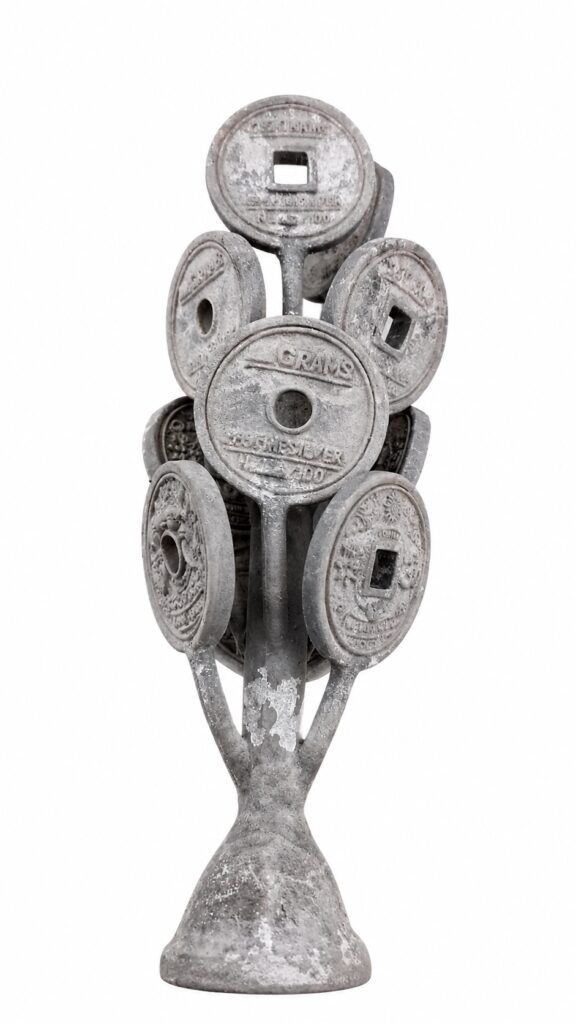
Do you wonder how silver casting tree look like? Most people imagine jewelry starting as a beautiful ring, pendant, or pair of earrings.
The truth is much different.
Before a piece of jewelry becomes polished, shiny, and ready to wear, it often begins its life looking something like the image below—a rough, gray, and rather unattractive structure known as a casting tree.
Many jewelry buyers, and even some aspiring jewelers, have never seen this stage of production.
What Is a Silver Casting Tree?
A casting tree is created during the lost-wax casting process, one of the most widely used manufacturing methods in the jewelry industry.
Multiple wax models are attached to a central wax stem, creating a structure that resembles a tree. After the investment and casting process, molten silver fills the empty spaces left by the wax.
The result is a solid silver structure containing many pieces connected together.
In this case, the casting tree was produced using 999 fine silver.
Why Does Silver Casting Tree Look So Ugly?
Because beauty comes later.
At this stage, the silver has just emerged from the casting process. It still contains:
- Oxidation from heat
- Investment residue
- Surface imperfections
- Sprues and runners that connected the metal flow
- No polishing or finishing
What you see is essentially the “raw birth” of jewelry.
It’s similar to seeing a rough marble block before it becomes a sculpture.
Every Coin Must Be Cut Apart
If you look closely, each coin design is connected to the central stem.
The next step is for a jeweler to:
- Cut each piece from the tree.
- Remove excess metal.
- File and smooth connection points.
- Polish the surface.
- Apply additional finishing if required.
Only after these processes will the final design begin to reveal itself.
Why This Matters
Many customers wonder why handcrafted silver jewelry carries production costs beyond the value of the silver itself.
This image provides the answer.
The raw silver casting is only the beginning.
Behind every finished piece are hours of:
- Casting
- Cutting
- Filing
- Sanding
- Polishing
- Quality control
The craftsmanship involved often exceeds the value of the metal itself.
The Transformation Is the Magic
The next time you admire a finished silver coin, pendant, or ring, remember that it probably started its life looking like this rough and unattractive casting tree.
What appears ugly today can become something beautiful tomorrow.
That transformation is where the true art of jewelry making begins.